

Every nutrition services director knows that it’s important to offer fresh fruit and vegetables in school. That produce delivers critical vitamins, minerals, and other nutrients for students’ growing brains and bodies. Buying, cooking, and serving it is the easy part. The challenge is getting students to eat it!
To help you increase fruit and vegetable consumption in your schools, we spoke to Destin Faria, MHS, RD, LD, a regional dietitian with Cuisines.
Meet the Childhood Nutrition Expert: Destin Faria
Faria is a registered and licensed dietitian with a Master of Health Science degree. She has years of experience working with kids, both as a pediatric dietitian at Dolly Parton Children’s Hospital in Knoxville, Tennessee, and as a volunteer with farm-to-school programs.
“I counseled children, adolescents, and their families on developing balanced, healthy eating patterns and overcoming picky eating,” she told The FruitGuys.
Faria’s Tips for Increasing Fruit and Vegetable Consumption in Schools
To encourage students to eat more fruit and vegetables, you have to keep their preferences in mind every step of the way. That includes how you cook the produce, how you serve it, and the activities you plan around it. Let’s dig in.
1. Cook Vegetables for Flavor First
Fruits come naturally packed with flavor, but some veggies can taste bland without the right preparation.
“Roasting, grilling, seasoning, or serving vegetables with an appealing dip can make a significant difference in acceptance,” Faria said.
2. Put the Good Stuff on Display
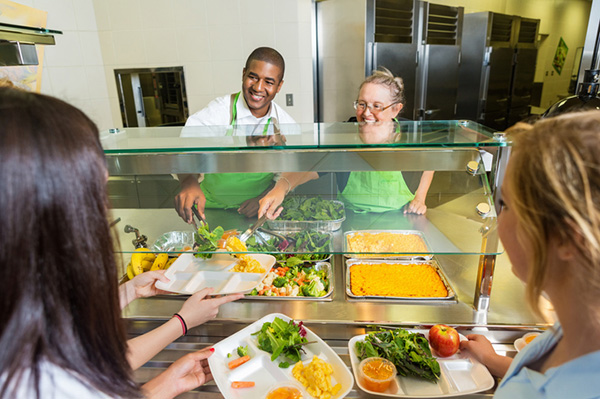
Position fruits and vegetables near the front of the serving line, and display them in creative and attractive ways. Arranging a variety of fruits by color to look like a rainbow is more eye-catching than simply putting them in a bowl.
3. Pair New Fruits and Veggies with Familiar Favorites
Pairing an unfamiliar fruit or vegetable with something students already know and love can make it easier to introduce new fresh fruits and vegetables in school. Think about the classic combination of celery and peanut butter, and try to use the same strategy.
Do your students love hot sauce? You could serve veggie sticks with a buffalo dip. Are they all about tacos? Add a new type of lettuce to the shredded lettuce topping or a new veggie to the fajita-style grilled vegetables.
4. Give Students a Choice
Kids like to have agency and choose what they eat—just like adults! So, offer them a couple of age-appropriate options to give them a sense of control. In preschool, ask if they’d like an apple or an orange at snack time. In high school, see if they want mango salsa or cilantro-lime slaw on their tacos. They’ll be more likely to eat what they choose.
5. Turn Snack Time into a Friendly Competition
Fruit and vegetable taste tests are a simple way to introduce students to new produce and learn which foods they enjoy. So, try hosting a fruit or veggie tasting in the cafeteria and ask students to vote for their favorite item. This can be as simple as setting out samples and displaying a photo of each fruit or veggie, then letting students add a sticker beneath the one they liked best. It makes the experience interactive and gives your team useful feedback about student preferences! To take what you learned a step further, connect the tasting experience to the cafeteria menu.
“When possible, serve the winning recipe or produce item at lunch so students can see that their opinions influenced the menu,” Faria said.
The FruitGuys Farm-to-School program makes tastings easy with free nutrition education, a Harvest of the Month student program, and interactive Nutrition Education Kits.
6. Get the Kids Cookin’
Offering cooking classes with fresh produce isn’t an option for every school, but if you have the budget and bandwidth for them, they can be a game-changer!
“Students could prepare a fruit salad, yogurt and fruit parfait, fresh salsa, or rainbow vegetable pinwheels. Even washing produce, tearing lettuce, measuring ingredients, or assembling a recipe gives students a sense of ownership,” Faria said.
After class, encourage the students to taste what they made. They’ll be more interested in trying it if they were part of the process.
7. Plant a School Garden
Like cooking classes, school gardens aren’t possible for every district—but growing your own ingredients can make a real impact. Students of all ages can get their hands dirty planting seeds, watering plants, pulling weeds, observing growth, and harvesting produce while a teacher watches.
“Gardening can be a calming, rewarding activity that builds patience, responsibility, and an understanding of where food comes from,” Faria said.
8. Try, Try, Try Again
Last but not least, if your students don’t fall in love with passion fruit, kiwi berries, or asparagus at first taste, don’t give up! Faria said that “providing repeated, pressure-free exposure” could be the key to success.
“Children may need to see or taste a food several times before accepting it,” she explained. “The goal should be exploration, not forcing students to eat or clean their plates.”
Still want more tips? Here’s another idea to consider.
Make Fruits and Vegetables Fill More of the Plate
Nutrition services have to follow strict guidelines for school meals, but there are ways to work within those guidelines to increase fruit and vegetable consumption in your schools. One that’s backed by research is to make sure produce visually fills up half the plate.
A Pennsylvania State University study found that kids will eat more fresh produce if:
- You serve them 50% more produce OR
- You swap 50% of the other food on their plate for fruits and vegetables
In the study, the kids who got more produce ate 24% more veggies and 33% more fruit. The kids who got produce instead of other food ate 41% more veggies and 38% more fruit.
A Penn State article on the study quoted Barbara Rolls, the school’s director of the Laboratory for the Study of Human Ingestive Behavior, saying, “When deciding what to feed kids, it’s easy to remember that half of the food should be fruits and vegetables. If you start seeing that you’re serving too much and have more waste, you could cut back the higher calorie-dense food while adding more produce.”
She also recommended serving fruits and vegetables as a first course, as snacks, or as part of mixed dishes to increase consumption even more.
Ready to Bring More Fresh Produce to Your Schools?
Buying fresh, high-quality produce is the first step toward encouraging students to eat more fruits and veggies at school, and The FruitGuys Farm-to-School Program makes it easy. We’ve been a school food supplier since 2008 and serve almost 100 districts across California, including many Fresh Fruit and Vegetable Program (FFVP) recipients! Check out our farm-to-school products to see what we can deliver to you.